
My Role:
UX Designer & Product Lead
AI Integration & Prompt Engineering
Tools Used:
Figma, Replit, OpenAI API, ChatGPT, n8n
Project Space:
Web
Enterprise
GovTech & HR Tech
UX Processes I Utilized:
Lean UX, Rapid Prototyping, Prompt Engineering, User Flows, Hi-Fidelity Mockups, Workflow Automation
The Challenge
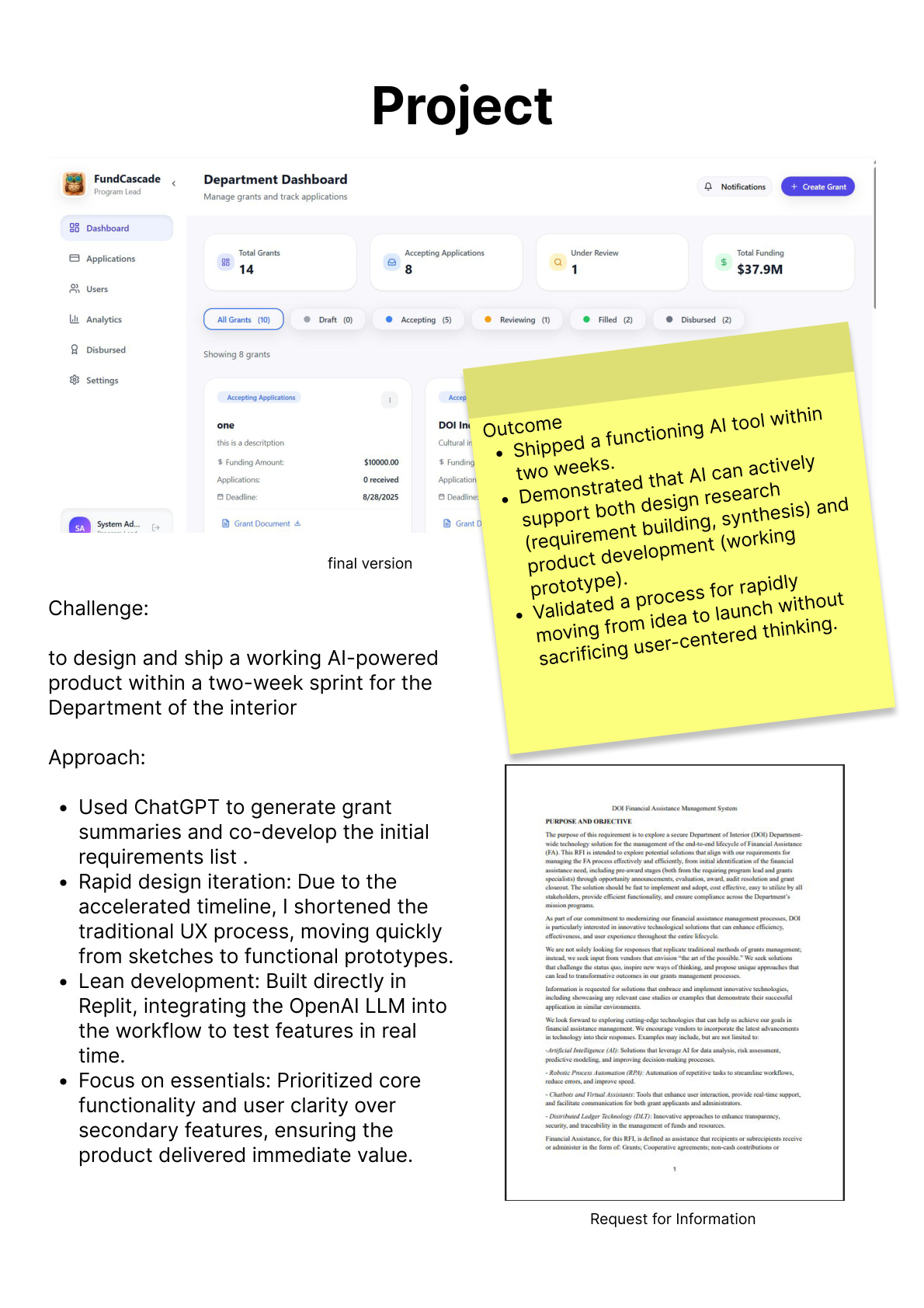
Design and ship a working AI-powered grant management product within a two-week sprint for the Department of the Interior. The RFI required a fully functioning tool — not a prototype — with a validated design and a live, integrated AI back end.
Approach
I used ChatGPT to generate grant summaries and co-develop the initial requirements list, reducing discovery time significantly. From there, the process was deliberately lean:
Rapid design iteration: I shortened the traditional UX process, moving quickly from sketches to functional prototypes.
Lean development: Built directly in Replit, integrating OpenAI's LLM into the workflow to test features in real time.
Focus on essentials: Prioritized core functionality and user clarity over secondary features, ensuring the product delivered immediate value within the sprint window.
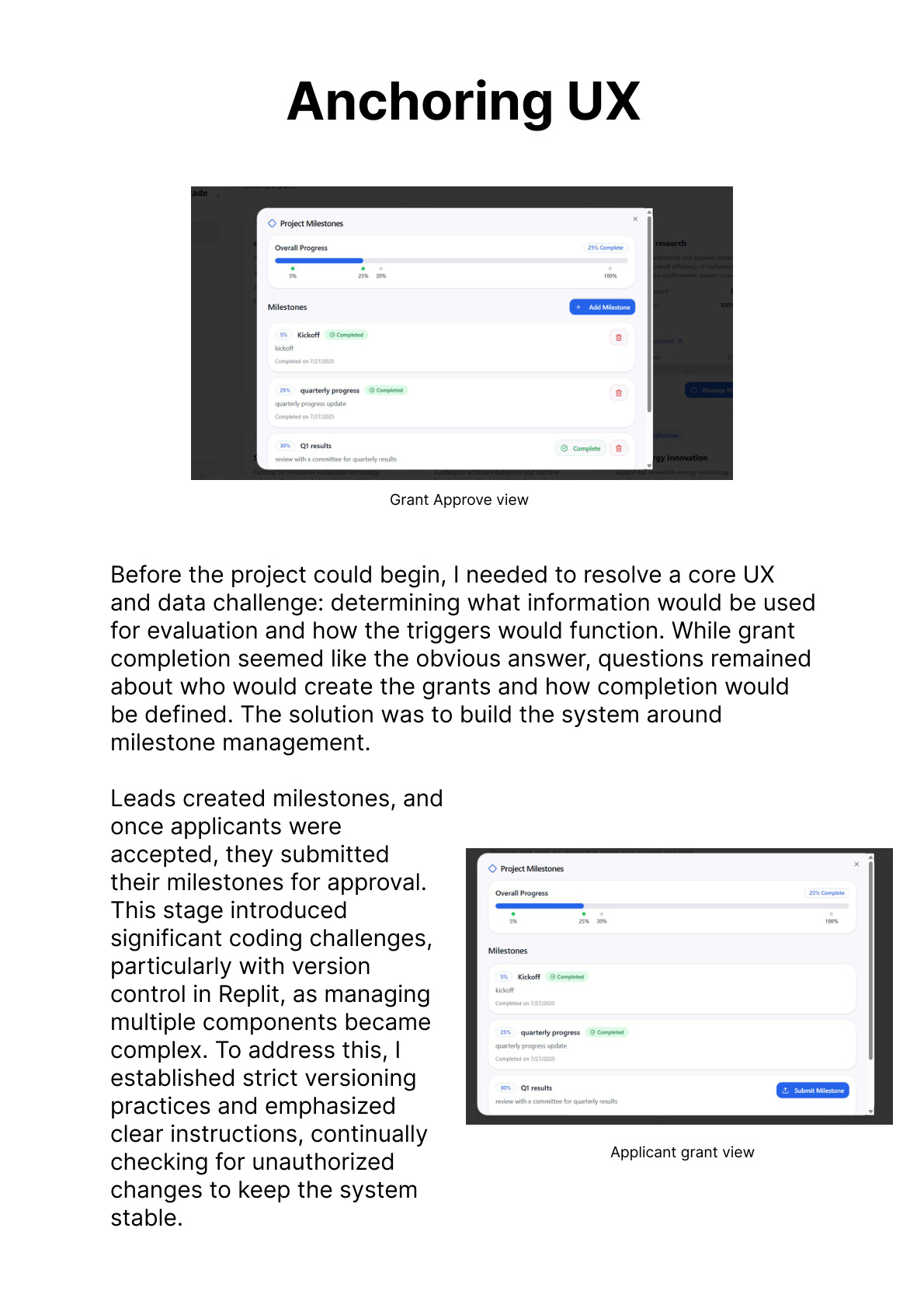
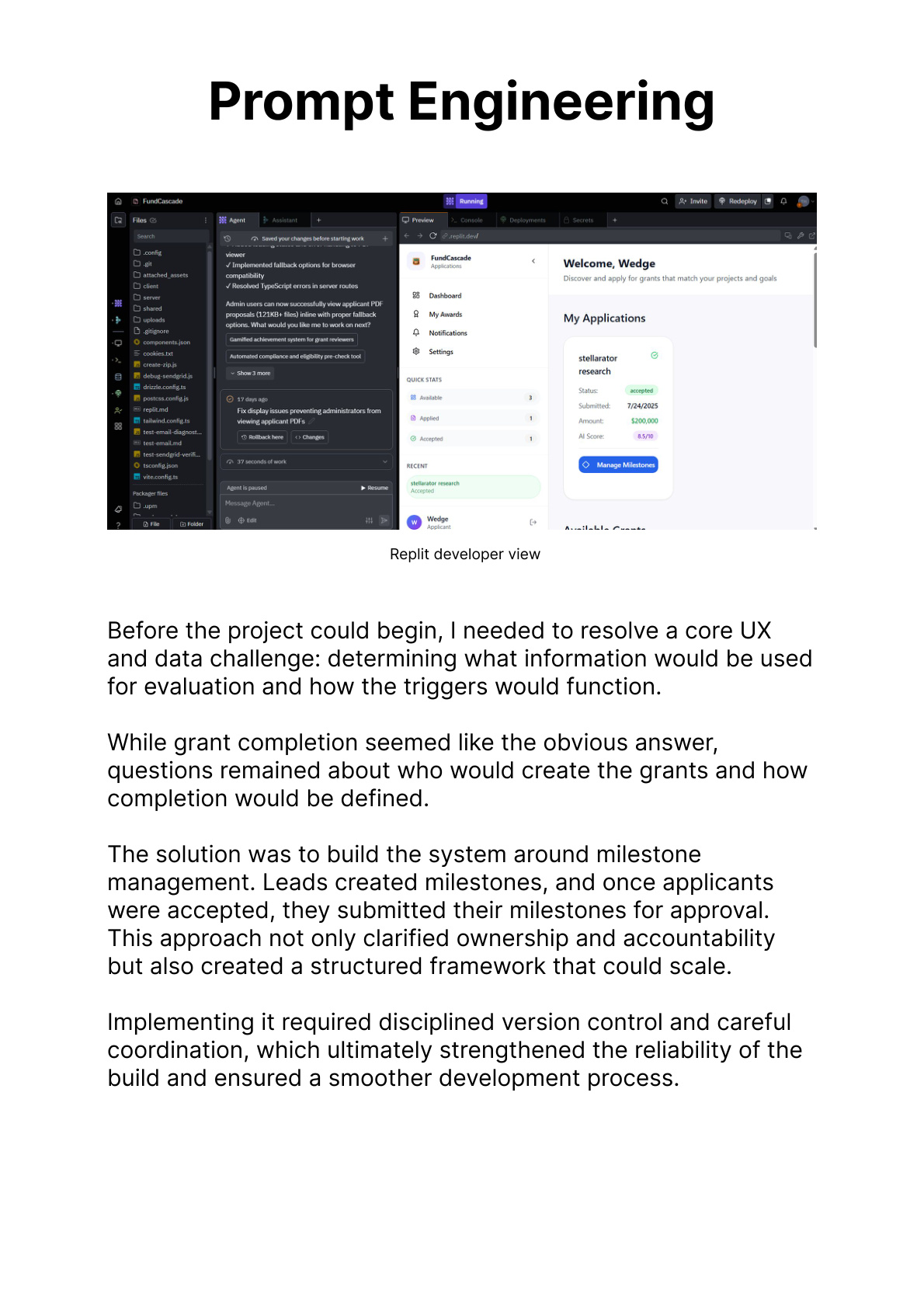
Before the project could begin, I needed to resolve a core UX and data challenge: determining what information would be used for evaluation and how the triggers would function.
Grant completion seemed like the obvious answer, but key questions remained — who creates the grants, and how is completion defined? Without a clear answer, AI summarization and automated approvals would have no reliable data to act on.
The solution: build the system around milestone management.
Grant leads created milestones. Once applicants were accepted, they submitted their milestones for approval. This approach clarified ownership and accountability at every stage, and created a structured framework the AI could reliably reference for status and scoring.
Development Challenge: This stage introduced significant version control complexity in Replit, as managing multiple interdependent components in parallel became difficult. I established strict versioning practices and clear change instructions, continually auditing for unauthorized changes to keep the system stable through the sprint.
With milestone management established as the data backbone, I could design the AI layer with precision. The key prompt engineering challenge was ensuring the LLM had the right context — the right scope of grant data, the right user role, and the right output format — for each of its four report types.
I built and iterated prompts directly in the Replit environment, testing outputs against real grant data. This tight feedback loop allowed me to validate prompt reliability without a traditional QA phase, which the two-week sprint timeline made impossible.
Implementing this required disciplined version control and careful coordination, which ultimately strengthened the reliability of the build and ensured a smoother development process. Each prompt was treated as a design artifact — versioned, tested, and refined like any other component.
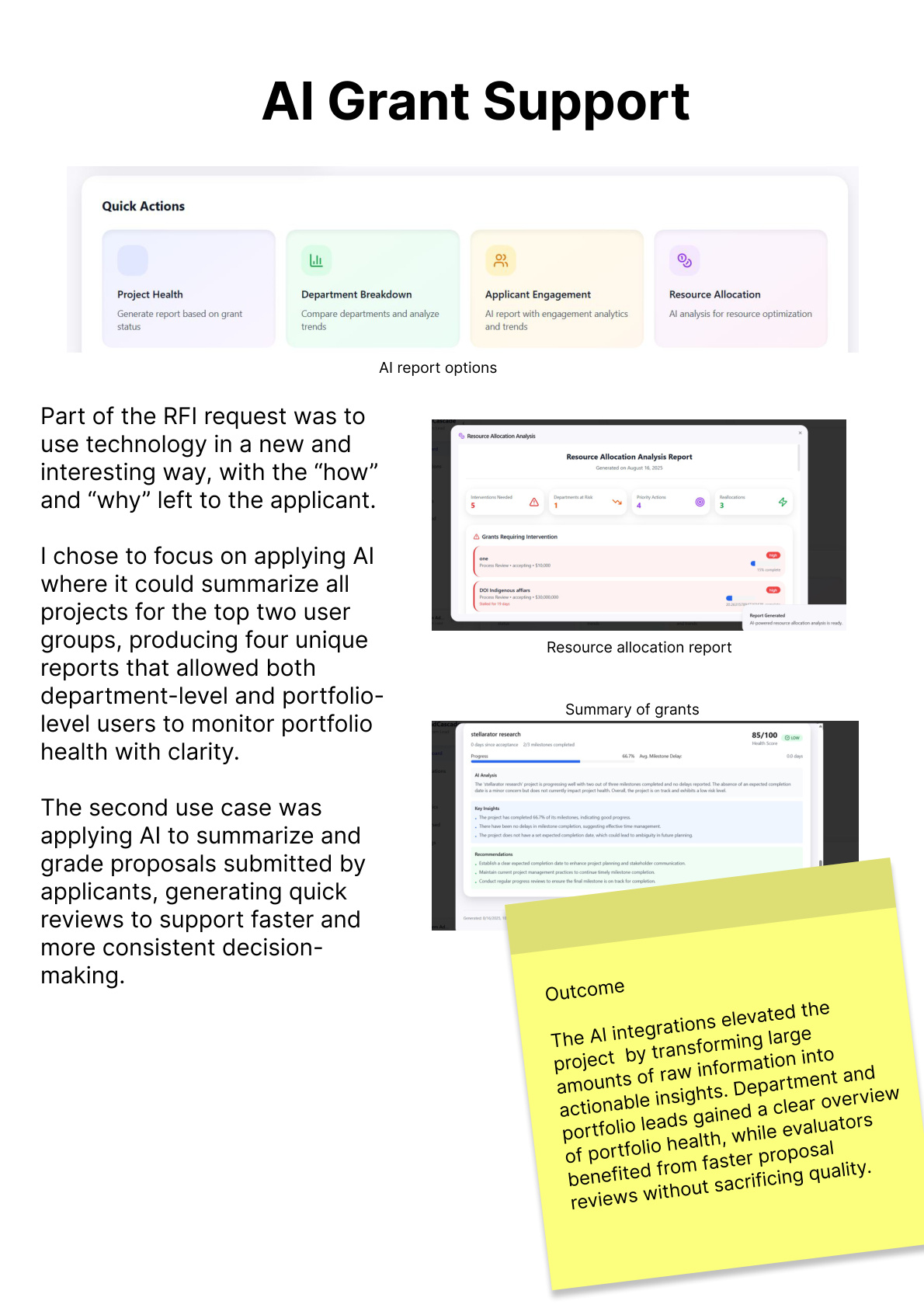
Part of the RFI request was to use technology in a new and interesting way — with the "how" and "why" left to the applicant. I chose to focus AI where it could surface the most value for oversight and decision-making.
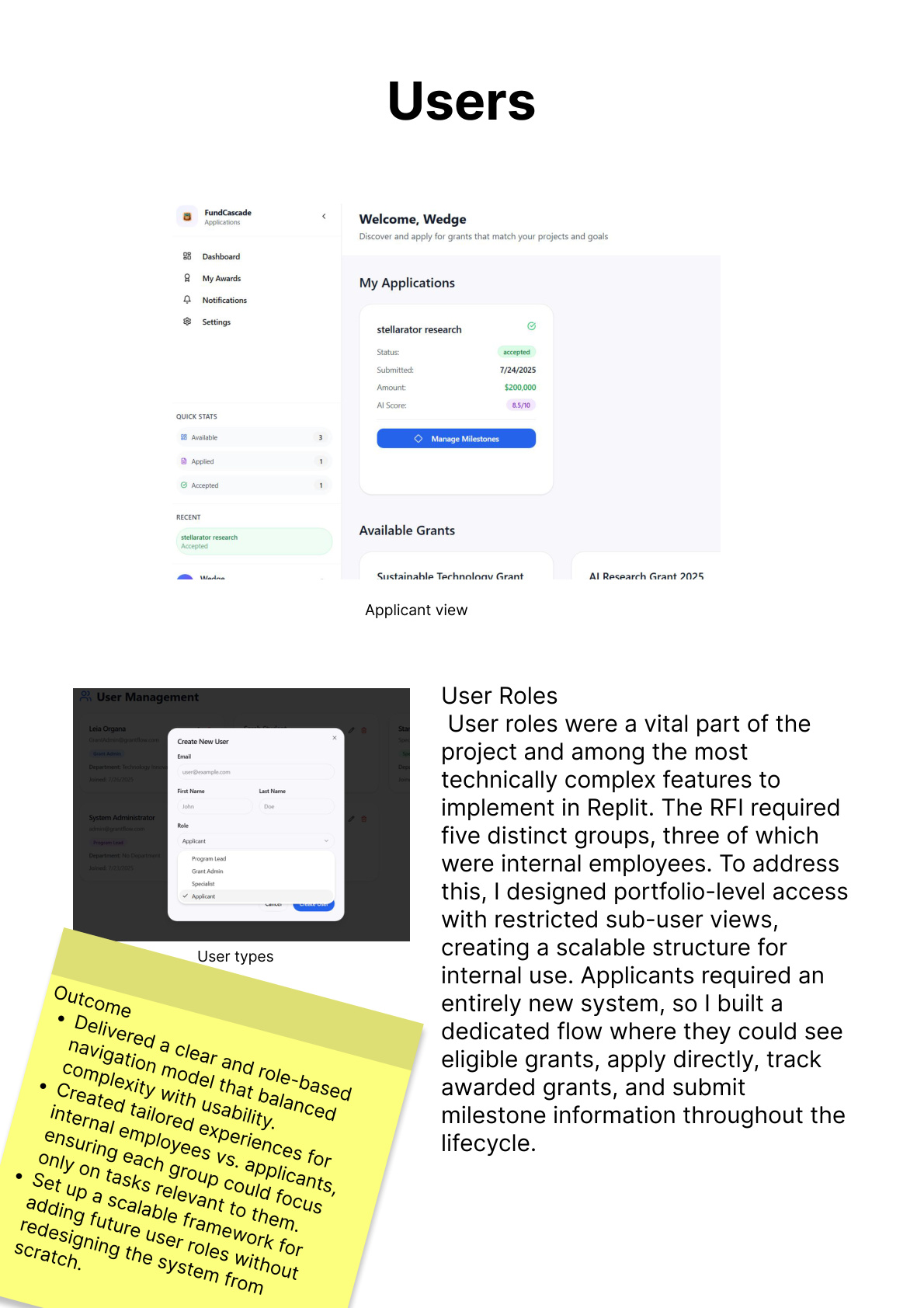
Portfolio Health Reports (2 views): The AI summarizes all active projects for the top two user tiers — Department-level and Portfolio-level managers. Each receives a tailored report, allowing both levels to monitor portfolio health with clarity without requiring manual rollups.
Proposal Grading: The second use case applied AI to summarize and grade applicant proposals, generating quick reviews to support faster and more consistent decision-making across reviewers.
Outcome: Four unique AI-generated reports — two for internal portfolio monitoring, one applicant-facing summary, and one reviewer scoring output — all flowing from the milestone data structure established earlier in the project.
The Problem
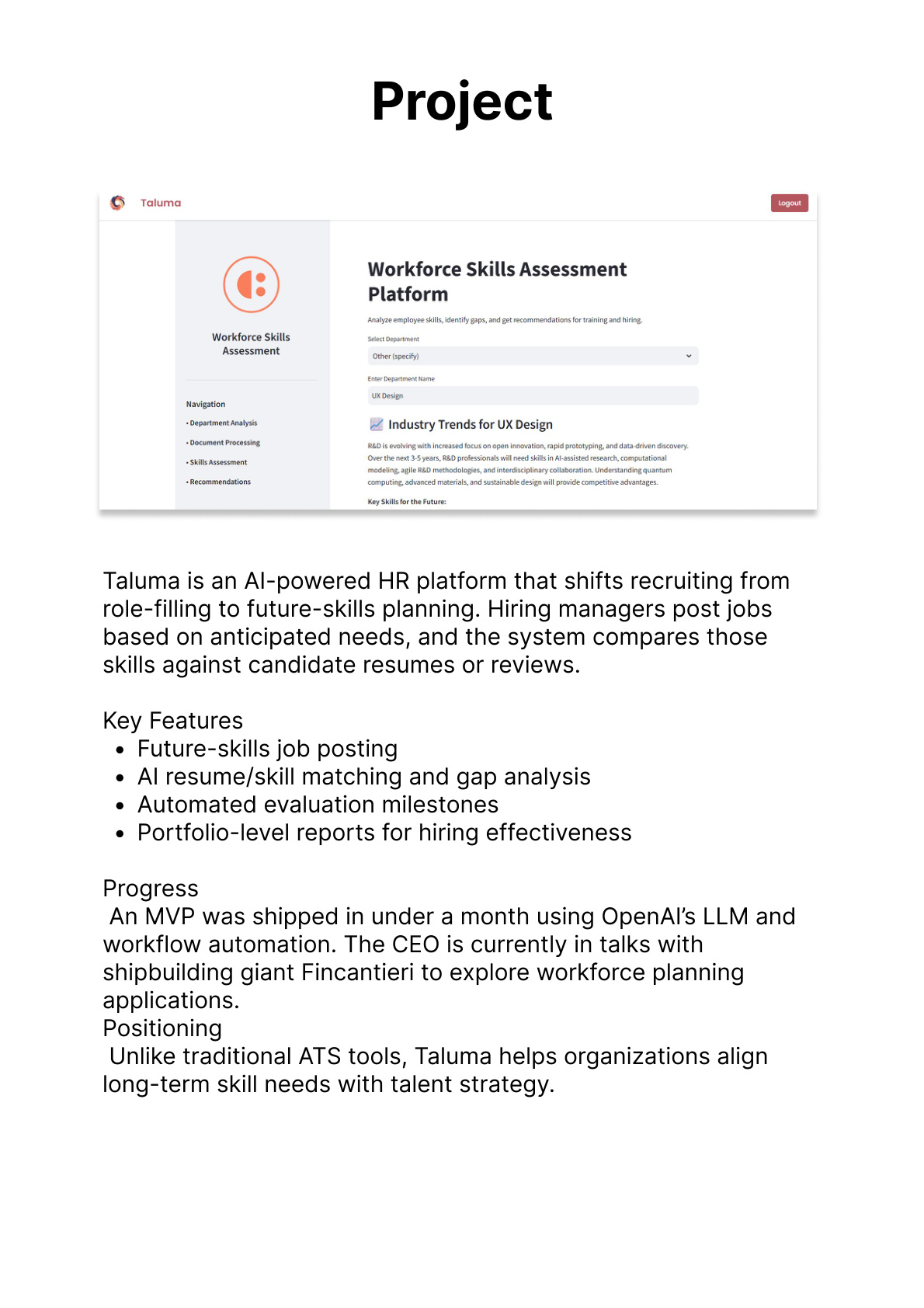
Traditional ATS tools are built for role-filling — reactive hiring that responds to open headcount. Taluma takes a different approach: shifting recruiting from filling today's roles to planning for tomorrow's skills.
Hiring managers post jobs based on anticipated future needs. The system then compares those skill requirements against candidate resumes and career reviews, surfacing gap analyses and match scores rather than simple keyword matches.
Positioning
Unlike legacy ATS platforms, Taluma helps organizations align long-term skill needs with talent strategy. It turns hiring into a forward-looking planning function rather than a reactive process.
Progress
An MVP was shipped in under a month using OpenAI's LLM and workflow automation. The CEO is currently in active talks with shipbuilding giant Fincantieri to explore enterprise workforce planning applications.
Future-Skills Job Posting: Hiring managers describe roles by anticipated skill needs, not just current requirements. This reframes the job posting as a planning artifact rather than a simple listing.
AI Resume & Skill Matching: The LLM compares candidate resumes against posted skill requirements, generating match scores and identifying specific skill gaps — enabling faster, more consistent screening.
Gap Analysis: Each candidate profile surfaces a clear breakdown of skills present vs. skills needed, giving hiring managers actionable data rather than subjective impressions.
Automated Evaluation Milestones: Candidates move through structured evaluation stages with automated checkpoints, reducing scheduling overhead and keeping the process consistent.
Portfolio-Level Hiring Reports: Leadership gets a rolled-up view of hiring pipeline health across all open roles — where skill gaps are clustering, where searches are stalling, and where the organization's talent trajectory is heading.
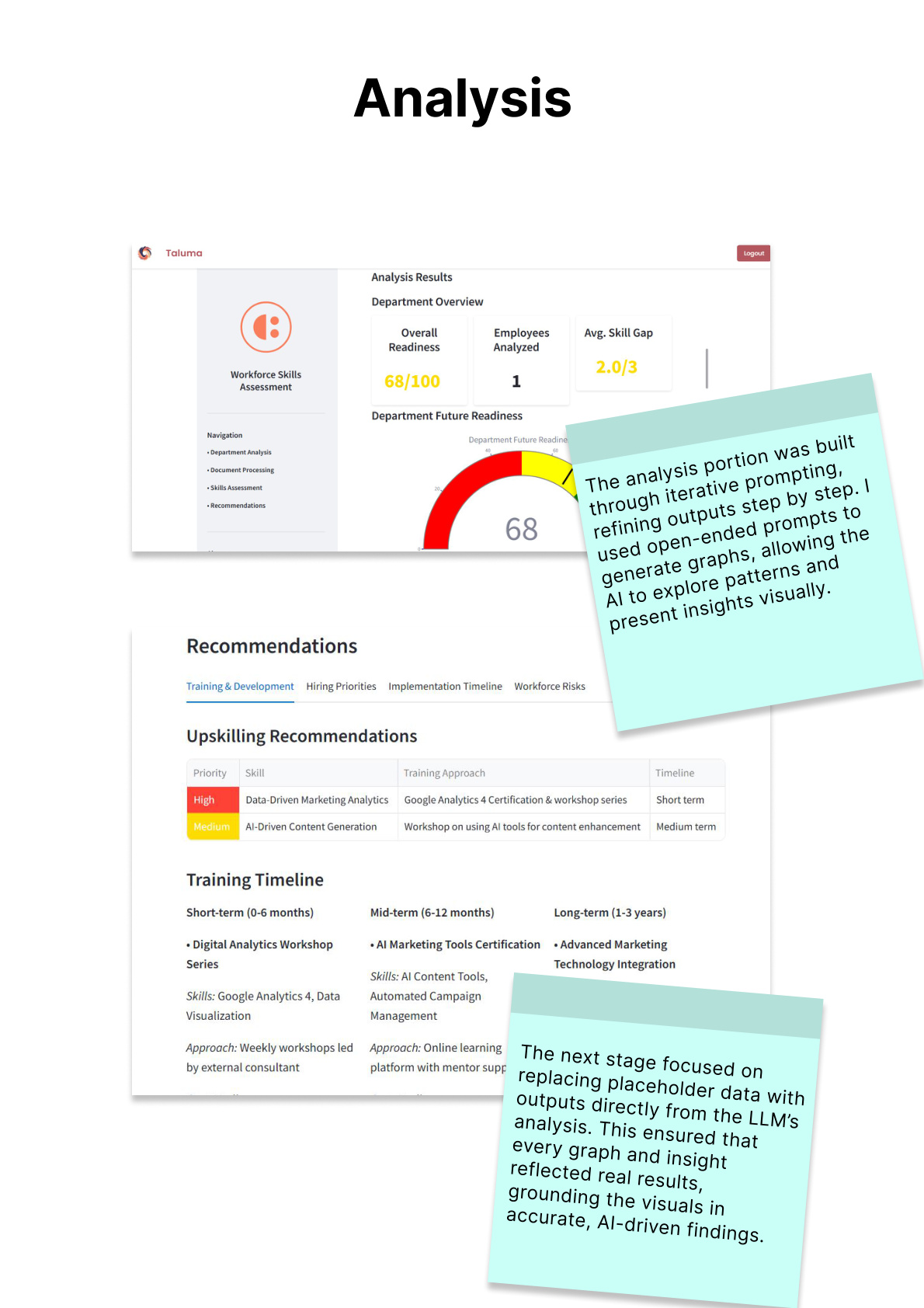
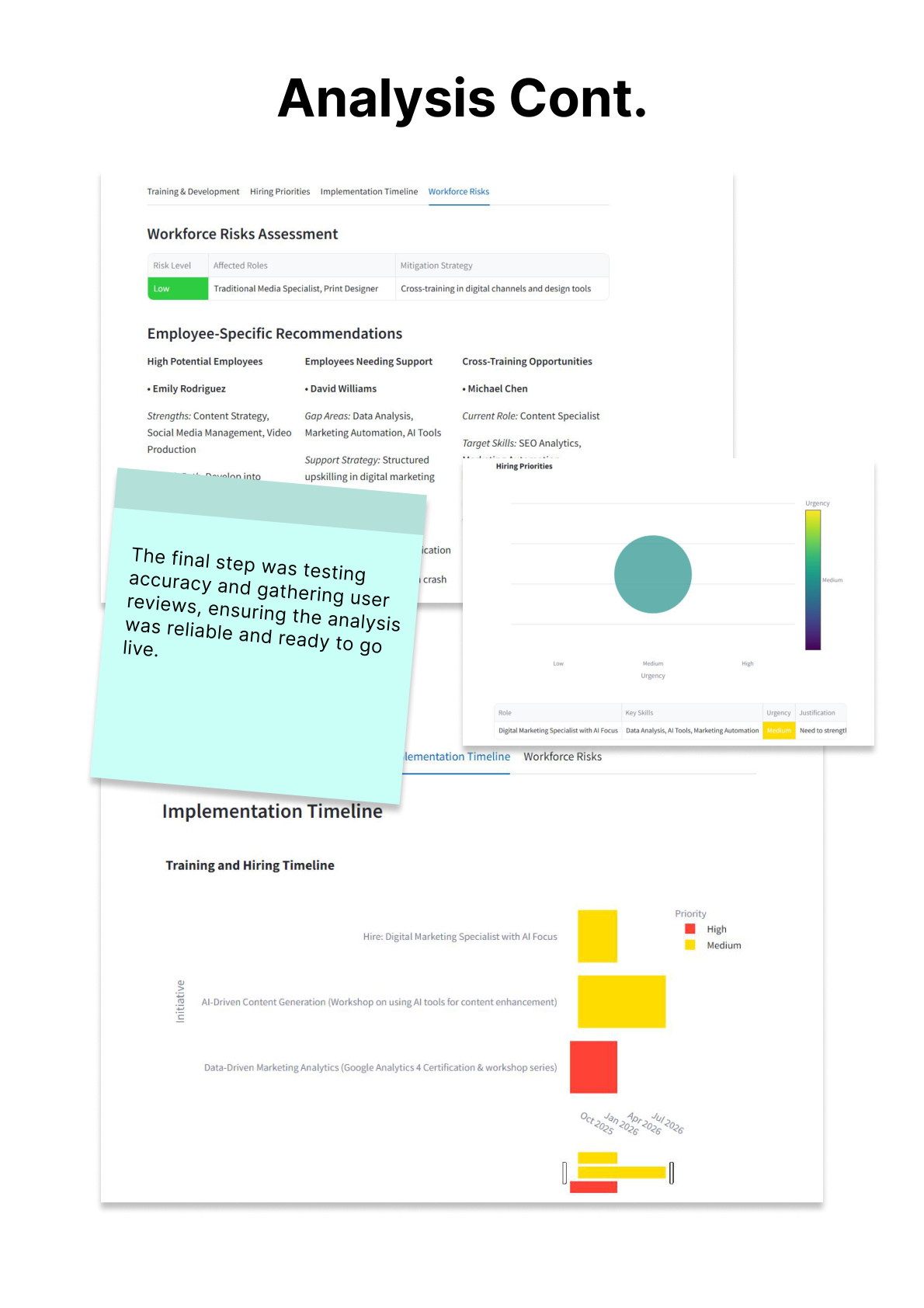
A core design challenge in Taluma was ensuring the AI outputs felt credible and actionable — not like black-box scores that hiring managers would second-guess. The analysis layer had to reflect real results and ground the visuals in accurate, AI-driven findings.
I designed the analysis views to clearly surface the LLM's reasoning alongside its scores. Rather than returning a single match percentage, the interface breaks down the evaluation by skill category — showing which requirements were met, partially met, or missing, with brief explanatory copy generated by the model.
This approach gave hiring managers a reviewable, defensible output rather than an opaque recommendation — building the trust in AI decision support that enterprise adoption requires.
What is n8n?
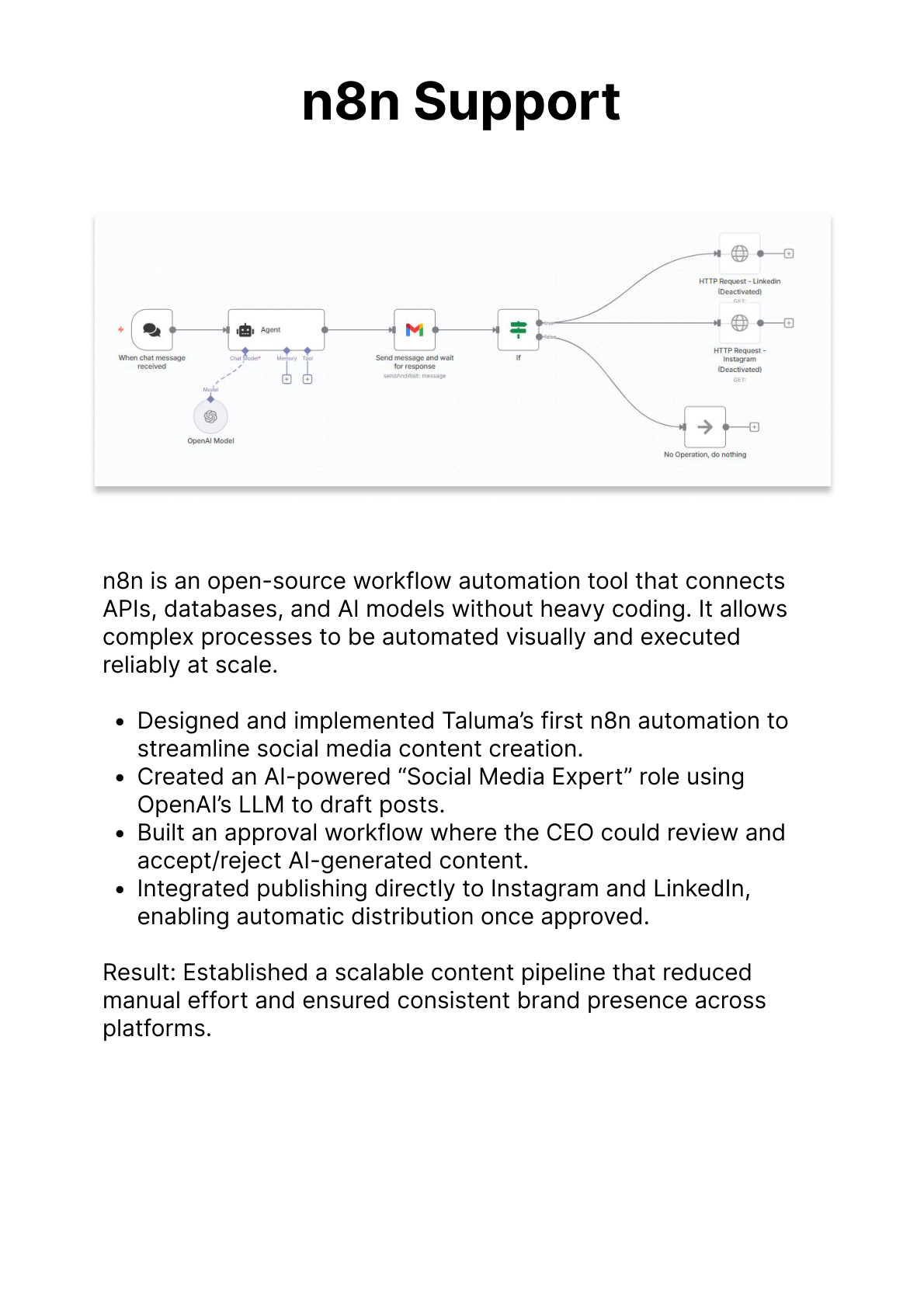
n8n is an open-source workflow automation tool that connects APIs, databases, and AI models without heavy coding. It allows complex processes to be automated visually and executed reliably at scale — a natural fit for extending Taluma's AI capabilities beyond the core product.
What I Built
I designed and implemented Taluma's first n8n automation to streamline social media content creation — removing a time-consuming manual bottleneck from the founding team's workflow.
AI Content Generation: Created an AI-powered "Social Media Expert" role using OpenAI's LLM to draft on-brand posts for Instagram and LinkedIn.
Approval Workflow: Built a review loop where the CEO could approve or reject AI-generated content before it published — maintaining brand control without requiring manual drafting.
Auto-Publishing: Integrated direct publishing to Instagram and LinkedIn, so approved content went live automatically with no additional steps.
Result: Established a scalable content pipeline that reduced manual effort and ensured consistent brand presence across platforms — freeing the founding team to focus on the product.
Both projects required a fundamental shift in how I approach UX: designing not just the interface, but the data structures, prompts, and outputs that make AI useful and trustworthy.
What I learned across both sprints:
AI needs clean data anchors. In Fund Cascade, the milestone framework was the foundation that made AI summarization reliable. Without that structure, the LLM had nothing consistent to reference. Designing the data model was as important as designing the screens.
Prompt engineering is a design skill. Writing prompts that produce consistent, appropriately scoped outputs — in the right voice, at the right level of detail, for the right user role — requires the same iterative thinking as UI design. It belongs in the UX process.
Trust is the UX problem in AI products. Both projects required explicit design work to make AI outputs feel credible and reviewable — not just correct. Users need to understand why the AI said what it said, or they won't act on it.